
COLORADO MILITARY DIVORCE GUIDE
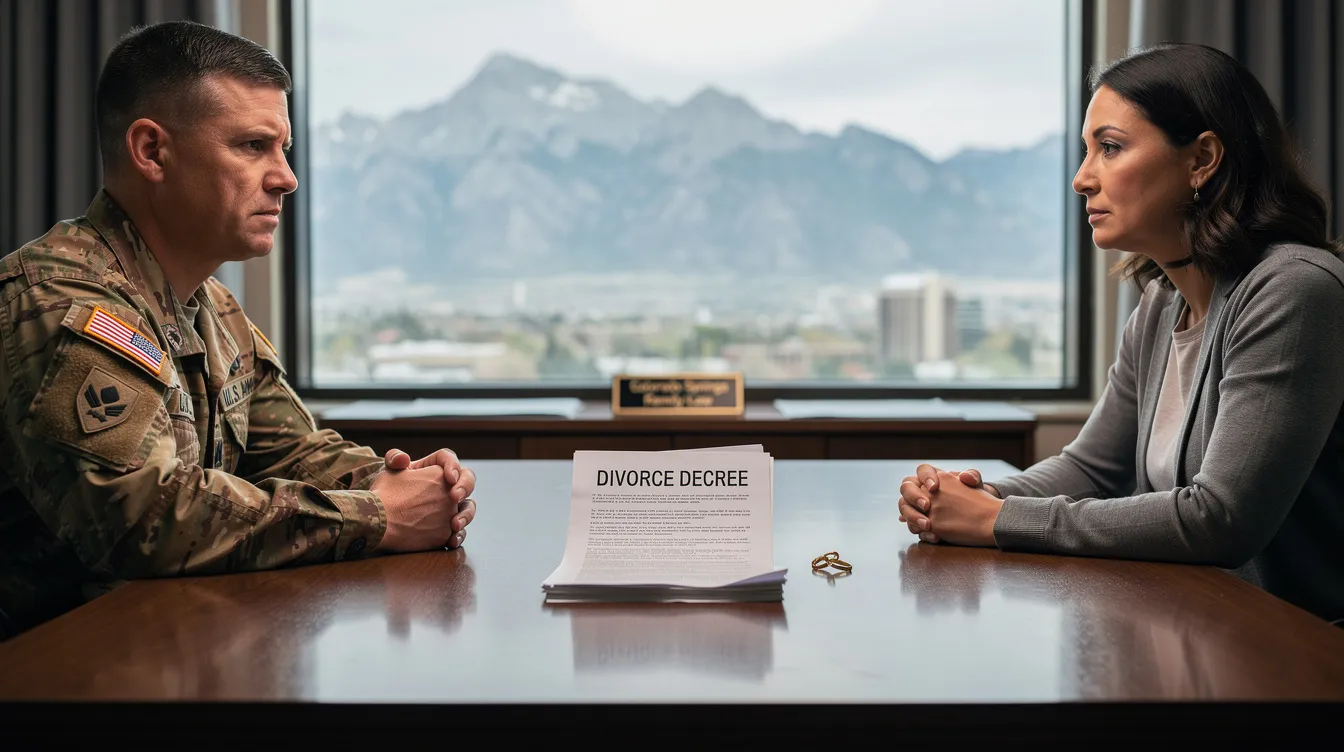
Military divorce runs on two tracks at once. Colorado's Uniform Dissolution of Marriage Act governs the divorce itself, while federal statutes control how military retired pay is divided, when a deployed service member can pause a case, and which benefits survive the decree.
If you are a service member or a military spouse in the Colorado Springs area, that overlap is where cases go wrong. A civilian divorce attorney can handle the dissolution and still draft a retirement order that the Defense Finance and Accounting Service rejects, or miss a Survivor Benefit Plan deadline that cannot be reopened.
This page explains how Colorado law and federal military law actually interact, what the well-known rules do and do not mean, and where the costly mistakes happen.
Every military divorce filed in Colorado answers to the same two bodies of law, whether the case is heard in El Paso County, Denver, or Pueblo. Colorado supplies the residency requirement, the equitable distribution standard, and the parenting framework. Federal law supplies the limits on dividing retired pay, the protections available to deployed members, and the eligibility rules for benefits that continue after the decree.
What changes from case to case is which federal provisions are actually in play. A twelve-year marriage to a member with eight years of service raises entirely different questions than a twenty-two year marriage to a retiree drawing VA disability compensation. The sections below work through those pieces in the order they tend to arise.
Colorado is an equitable distribution state, meaning marital property is divided fairly rather than automatically in half. That principle governs the marital share of a military pension the same way it governs a house or a bank account, subject to the federal ceilings described later on this page. For a broader statewide overview, see our guide to Colorado military divorce.
TABLE OF CONTENTS
- Colorado Military Divorce Guide
- Why Military Families Trust Our Firm
- Jurisdiction in a Colorado Military Divorce
- Dividing Military Retired Pay
- Servicemembers Civil Relief Act Protections
- Child Custody and Support for Military Families
- TRICARE, SBP, and Other Military Benefits
- How Our Military Divorce Process Works
- Mistakes That Cost Military Families
- Military Bases and Areas We Serve
- Frequently Asked Questions
- Schedule Your Free Consultation
- Sources
WHY MILITARY FAMILIES TRUST OUR FIRM
Moran, Allen & Associates handles family law matters for service members and military spouses throughout El Paso, Teller, and Fremont counties. Military divorce is a recurring part of that practice rather than an occasional exception.
- Prior Military Service. Our firm includes multiple attorneys who have served in the United States Army and the United States Air Force, as well as attorneys who are married to active-duty service members or veterans. They bring firsthand military experience and insight to every case, along with a deep understanding of the unique challenges military service places on both service members and their families. This perspective allows them to advocate with knowledge, empathy, and a clear understanding of the issues military families face.
- Federal and state law together. We work with the Uniformed Services Former Spouses' Protection Act, the Servicemembers Civil Relief Act, and Colorado's Uniform Dissolution of Marriage Act as a single problem, because that is how they reach your case.
- Orders drafted to survive review. A retirement division order has to satisfy federal formatting and jurisdictional requirements before DFAS will act on it. We draft to that standard from the start.
- Trial experience. Our attorneys include former felony prosecutors, and we prepare cases for hearing rather than assuming settlement.
- Free initial consultations for service members and military spouses, with scheduling that accounts for deployment timelines and pending PCS orders.
JURISDICTION IN A COLORADO MILITARY DIVORCE
Jurisdiction is the first question in every military case, and it is really three separate questions. Getting one right does not settle the others.
Jurisdiction to Grant the Divorce
Under C.R.S. § 14-10-106, a Colorado district court may enter a decree of dissolution when one of the parties has been domiciled in Colorado for 91 days preceding the start of the proceeding. A further 91 days must pass after the court acquires jurisdiction over the responding spouse before a decree can enter.
Note the standard is domicile, not residence and not duty station. Domicile requires physical presence combined with the intent to make Colorado home, shown through things like a Colorado driver's license, vehicle registration, voter registration, or a state of legal residence election.
Being stationed at Fort Carson does not by itself make a service member a Colorado domiciliary. The Colorado Supreme Court, in a 1973 case held, "The bald fact that the plaintiff-husband was stationed in Colorado for ninety days did not create such a significant contact with Colorado as to permit Colorado courts to dissolve the marriage. . . ." Viernes v. District Court, 181 Colo. 284, 509 P.2d 306 (1973).
However, a Colorado court could find that a service member is domiciled in Colorado. Factors contributing to this could be if the service member gets a Colorado driver's license, registers to vote in Colorado, and/or registers their vehicle in Colorado.
There is a second path that is frequently overlooked. If the non-military spouse is domiciled in Colorado, that alone can supply the court's authority to dissolve the marriage, regardless of where the service member claims legal residence.
An example of this is if the non-military spouse moves back to Colorado, but the service member remains at their duty station in Florida, the Colorado court could have jurisdiction to dissolve the marriage based on the non-military spouse being domiciled in Colorado.
Jurisdiction to Divide Retired Pay
Dividing military retired pay requires its own, stricter jurisdictional basis. Under 10 U.S.C. § 1408(c)(4), the court must have jurisdiction over the service member by reason of residence in the state other than because of military assignment, by reason of domicile in the state, or by the member's consent to the court's jurisdiction.
This is the trap. A Colorado court can have every right to grant the divorce and still lack authority to divide the pension, because a spouse's residency satisfies the first requirement but not the second.
Using our example from above, Florida may be a more appropriate state to file for divorce because Florida may have jurisdiction to divide the military retirement pay.
Jurisdiction Over the Children
Parenting matters are governed separately by the Uniform Child-Custody Jurisdiction and Enforcement Act, which generally turns on the child's home state over the preceding six months. For families who have PCS'd recently, the divorce and the custody case can belong in different states.
Under C.R.S. § 14-13-201, there are only four ways Colorado can find jurisdiction to make an initial child custody determination. Those are, in priority order, Colorado is the home state, the children and parents have "significant connections" to Colorado, Colorado is the more "appropriate forum", or Colorado is the last resort.
In our Florida example, if the non-military spouse and the children lived in Florida for the past two years before relocating to Colorado three months ago, Florida would likely be considered the children's "home state." In that situation, it is generally advisable to either file in Florida or wait until Colorado becomes the children's home state under the applicable jurisdictional rules.
Even then, determining jurisdiction can be complex. Military families frequently face unique challenges in establishing which state qualifies as the children's home state, particularly when frequent relocations are involved.
DIVIDING MILITARY RETIRED PAY
The Uniformed Services Former Spouses' Protection Act does not award a former spouse anything. It authorizes qualifying state courts to treat disposable retired pay as marital property under state law, subject to federal limits. Colorado then applies equitable distribution under C.R.S. § 14-10-113.
Disposable retired pay is gross retired pay less the deductions specified in 10 U.S.C. § 1408. Those deductions can include recoupments owed to the United States, court-martial forfeitures, amounts waived in order to receive VA disability compensation, certain Chapter 61 disability retirement amounts, and Survivor Benefit Plan premiums attributable to the former spouse.
A common misconception about dividing military retired pay is: "We weren't married for at least 10 years, so my spouse can't receive any portion of my military retirement." This is simply not true.
Under Colorado law, military retirement earned during the marriage is generally considered marital property, regardless of the length of the marriage. As a result, Colorado courts may determine that even in relatively short marriages, a former spouse is entitled to a share of the military retirement benefits that accrued during the marriage.
That does not mean, however, that a court will divide a military retirement in every case. In very short marriages (such as those lasting only one or two years) the marital portion of the retirement may be so small that the court determines it is not practical or worthwhile to divide.
The key point is that the length of the marriage alone does not automatically prevent a military retirement from being divided. Even if the marital share is ultimately minimal, the court still has the authority to determine whether any portion of the retirement should be awarded to the former spouse.
Calculating the Marital Share
Colorado divides the marital portion of a pension using a time-rule approach developed in In re Marriage of Gallo, 752 P.2d 47 (Colo. 1988) and In re Marriage of Hunt, 909 P.2d 525 (Colo. 1995). Broadly, the marital share is the service accumulated during the marriage over total creditable service.
Federal law now constrains that calculation. When a decree divides retired pay and becomes final before the member retires, 10 U.S.C. § 1408(a)(4)(B) computes the pay to be divided from the member's retired pay base and years of service on the date of the decree, increased by later cost-of-living adjustments. This "frozen benefit" rule applies to decrees that became final after December 23, 2016.
The practical effect is significant. Promotions and years of service earned after the decree no longer flow through to the former spouse's share in the way Hunt alone would suggest. Which retirement system applies also matters, since the Blended Retirement System carries a smaller pension multiplier alongside a separate Thrift Savings Plan account.
What the 10/10 Rule Actually Does
As mentioned above, the 10/10 rule is the single most misunderstood concept in military divorce. It determines whether DFAS will pay the former spouse's property award directly, and nothing more.
Direct payment requires at least 10 years of marriage overlapping at least 10 years of creditable service. Where that overlap is shorter, a Colorado court may still award a marital share of disposable retired pay. The award simply has to be collected from the member rather than from DFAS.
Separately, direct payments to a former spouse for property division are capped at 50 percent of disposable retired pay. That cap is a payment limit, not a ceiling on what a court may award.
VA Disability and the Waiver Problem
VA disability compensation is not divisible marital property. Retired pay waived in order to receive it is excluded from disposable retired pay by statute, and the Supreme Court held in Mansell v. Mansell, 490 U.S. 581 (1989) that states are preempted from dividing the waived portion.
The Court closed the indirect route in Howell v. Howell, 581 U.S. 214 (2017), holding that a state court may not order a veteran to reimburse or "indemnify" a former spouse for the reduction a VA waiver causes. Colorado follows the same rule, "disability payments were not divisible under the Uniformed Services Former Spouses' Protection Act (USFSPA), and the wife was not entitled to share in them". In re Marriage of Tozer, 410 P.3d 835 (Colo. App. 2017).
None of that makes VA disability irrelevant to support. Colorado's gross income definitions for maintenance, in C.R.S. § 14-10-114(8), and for child support, in C.R.S. § 14-10-115(5), both begin with income from any source. In In re Parental Responsibilities Concerning M.E.R-L., 2020 COA 173, the Colorado Court of Appeals held that a trial court did not err by including a father's VA disability benefits in his gross income for child support, and that the federal Uniformed Services Former Spouses' Protection Act does not prohibit it.
Federal law also does not stop a state court from enforcing child support against those benefits. In Rose v. Rose, 481 U.S. 619 (1987), the U.S. Supreme Court held that a state court may hold a disabled veteran in contempt for failing to pay child support even when the veteran's only means of paying is VA disability compensation. How the benefit is treated for maintenance should be addressed directly when maintenance is calculated.
SERVICEMEMBERS CIVIL RELIEF ACT PROTECTIONS
The Servicemembers Civil Relief Act, 50 U.S.C. § 3901 et seq., does not prevent a divorce from being filed against a deployed service member. It does not stop the case automatically. It provides procedural protections that have to be invoked correctly.
Stay of Proceedings
Under 50 U.S.C. § 3932, a court must grant a stay of at least 90 days when a qualifying application is made. The applicant must be in military service or within 90 days after release, must have notice of the proceeding, and must submit two things.
The first is a communication stating how current military duty materially affects the ability to appear, along with a date the member will be available. The second is a letter from the commanding officer confirming that duty prevents appearance and that leave is not authorized.
Additional stays are available but are not automatic. They require a showing that the material effect continues, and the court retains discretion.
The trigger is material effect on the ability to participate, not the existence of orders. A service member stationed stateside with regular access to counsel and video hearings may not qualify at all.
Default Judgment Protections
Before entering a default judgment, a court must require an affidavit or declaration as to the defendant's military status under 50 U.S.C. § 3931. Where the defendant is in military service, the court must appoint an attorney to represent the absent member before proceeding.
If a default judgment is entered against a service member during military service, or within 60 days after termination or release, the member may apply to reopen it. That application must show that military service materially affected the ability to defend and that a meritorious or legal defense exists, and it must be filed within 90 days after military service ends.
These two periods are frequently confused with each other and with a general 60-day pause on litigation. There is no such general pause.
CHILD CUSTODY AND SUPPORT FOR MILITARY FAMILIES
Colorado allocates parental responsibilities, meaning decision-making authority and parenting time, under C.R.S. § 14-10-124. The standard is the best interests of the child, and Colorado has no statutory presumption of equal parenting time; although the court will generally attempt to fashion a 50/50 parenting plan unless and until there is a reason not to.
Deployment and Parenting Time
Colorado's Uniform Deployed Parents Custody and Visitation Act, at Title 14, Article 13.7, supplies the procedures for deployment-related arrangements.
Where there has already been a determination of custody, a deploying parent must notify the other parent in a record no later than 12 calendar days after receiving deployment orders, unless circumstances of service reasonably prevent it. Each parent then provides a plan for their share of custodial responsibility as soon as reasonably possible.
A court may grant temporary caretaking authority during deployment to an adult family member or another adult with whom the child has a close and substantial relationship, subject to statutory limits and the child's best interests. A deploying parent cannot simply assign parenting time to anyone they choose.
Deployment supports a temporary order. It does not support a permanent reallocation of parental responsibilities without the deploying parent's agreement, and arrangements made for the deployment end when the deployment does.
PCS Moves and Relocation
Orders to a new duty station do not authorize moving a child out of state. Colorado's relocation standards still apply, and so do interstate custody rules.
Military parenting plans should address travel costs, school transitions, time zones, electronic contact, and what happens when orders arrive, rather than leaving those questions to be litigated later. We handle child relocation matters that arise from military moves.
Child Support and Military Pay
Colorado child support calculations generally treat military compensation as gross income, including basic allowance for housing and basic allowance for subsistence, even though those allowances are not taxable. Leaving allowances out of the worksheet understates income substantially.
Colorado's child support guidelines changed materially on March 1, 2026 under House Bill 25-1159, which amended C.R.S. § 14-10-115. The 93-overnight threshold that separated the old Worksheet A and Worksheet B calculations was replaced with a graduated parenting time credit that begins with the first overnight.
The same legislation raised the combined monthly adjusted gross income ceiling for guideline calculations from $30,000 to $40,000 and updated the basic support schedules. For military families with orders entered before March 1, 2026, the change may itself support a motion to modify. Our child support attorneys can run your numbers under the current guidelines.
TRICARE, SBP, AND OTHER MILITARY BENEFITS
The 20/20/20 and 20/20/15 Rules
An unremarried former spouse may qualify for TRICARE, commissary, exchange, and certain morale, welfare, and recreation privileges under the 20/20/20 rule. It requires at least 20 years of marriage, at least 20 years of creditable service, and at least 20 years of overlap between the two.
Continued eligibility remains subject to federal conditions, including rules on remarriage and on enrollment in an employer-sponsored health plan. A former spouse meeting a 20/20/15 overlap generally receives far less, typically up to one year of transitional TRICARE coverage.
These thresholds are set by federal law. They cannot be negotiated, ordered, or waived by a Colorado court, which makes knowing where you fall essential before settlement rather than after.
Survivor Benefit Plan
Military retired pay stops when the retiree dies. The Survivor Benefit Plan is a separate annuity that continues a portion of that income to a designated beneficiary, and a share of retired pay awarded in a decree is worth nothing after death without it.
A decree should state expressly whether former spouse coverage is awarded, at what base amount, and who pays the premium. Where coverage is ordered, the former spouse's deemed election request generally must reach DFAS within one year of the order requiring it, even if the member has not yet retired. That deadline is unforgiving.
Thrift Savings Plan
A Thrift Savings Plan account is divided by a Retirement Benefits Court Order, which goes to the TSP Court Order Center rather than to DFAS. For members under the Blended Retirement System, the TSP balance is often a larger share of the retirement picture than the pension.
HOW OUR MILITARY DIVORCE PROCESS WORKS
Step 1: Free Consultation
We review your Leave and Earnings Statement, rank and service history, retirement system, DD Form 214 if you have separated, deployment and PCS timeline, and your children's situation. From that we identify which of the jurisdictional questions are actually in play and where the case should be filed.
Step 2: Strategy and Filing
We inventory every military and civilian asset, including retired pay, TSP, SBP elections, and benefit eligibility, and separate marital from separate property under Colorado law. Filings include the military status disclosures federal law requires, and we prepare or respond to SCRA stay materials as needed.
Branch regulations on interim family support can apply while no court order exists, but they do not substitute for a Colorado support order and they end once one is entered. We move to get enforceable orders in place.
Step 3: Final Orders and Follow-Through
Final orders are drafted to divide disposable retired pay in language DFAS will accept, to address the frozen benefit rule where it applies, and to fix SBP coverage and premium responsibility explicitly. We also handle the follow-through: the DFAS application where the 10/10 requirement is met, TSP order processing, and SBP election deadlines.
MISTAKES THAT COST MILITARY FAMILIES
- Treating the 10/10 rule as an entitlement test. Spouses walk away from a pension claim they were entitled to pursue, and members concede one they could have contested, because both sides misread what the rule governs.
- Assuming deployment stops the case. The SCRA stay requires a written application and a commanding officer's letter. Service members who assume the protection is automatic lose the chance to participate.
- Ignoring the Survivor Benefit Plan. A decree that divides retired pay but says nothing about SBP can leave a former spouse with an award that ends the day the retiree dies, and the deemed election window is one year.
- Leaving allowances unaddressed in support calculations. BAH and BAS are untaxed, and Colorado's income definitions do not name them. The child support definition does include significant in-kind payments received in the course of employment that reduce personal living expenses, so how the allowances fit should be argued and documented when the worksheet is prepared, not assumed.
- Confusing duty station with domicile. Filing on the assumption that stationing establishes residence can produce orders that are challenged later, particularly on the retired pay division.
- Vague retirement division language. DFAS applies strict requirements. An order that a Colorado judge signs without objection can still be returned unprocessed, leaving the former spouse to collect from the member directly.
MILITARY BASES AND AREAS WE SERVE
- Fort Carson, and the Fountain, Security-Widefield, and on-post housing communities
- Peterson Space Force Base, and the Powers corridor, Stetson Hills, and Briargate neighborhoods
- Schriever Space Force Base, and eastern El Paso County
- Cheyenne Mountain Space Force Station and NORAD, including personnel with clearance considerations
- United States Air Force Academy, and the northern Colorado Springs and Monument areas
- Teller County, including Woodland Park and Cripple Creek, through our Woodland Park family law practice
- Fremont County, including Cañon City and surrounding communities
Peterson, Schriever, and Cheyenne Mountain were redesignated as Space Force installations in July 2021. Older material still refers to them as Air Force bases, which is worth knowing when you are comparing what different firms have published.
FREQUENTLY ASKED QUESTIONS
How does the 10/10 rule affect my military divorce?
The 10/10 rule decides whether DFAS will send a former spouse's share of retired pay directly, which requires at least 10 years of marriage overlapping at least 10 years of creditable service. It does not decide whether a court may award a share at all.
If the overlap is shorter, a Colorado court can still award a marital portion of disposable retired pay, but it must be paid by the member and enforced through other means.
Can I get divorced while deployed?
Yes. A divorce can be filed and can proceed while a service member is deployed. If current military duties materially affect the ability to appear, the Servicemembers Civil Relief Act allows a stay request under 50 U.S.C. § 3932, which requires a written statement of the material effect and expected availability plus a commanding officer's letter confirming that leave is not authorized.
A qualifying application must be granted for at least 90 days, and further stays require a continuing material effect. Colorado law also permits testimony by electronic means in deployment cases when personal appearance is not reasonably available.
What happens to my VA disability in a divorce?
VA disability compensation cannot be divided as marital property, and retired pay waived to receive it is excluded from disposable retired pay. Under Howell v. Howell and Colorado's In re Marriage of Tozer, a court cannot order a veteran to reimburse a former spouse dollar for dollar for a reduction caused by a post-divorce waiver.
That does not mean VA disability is ignored for support. In In re Parental Responsibilities Concerning M.E.R-L., 2020 COA 173, the Colorado Court of Appeals upheld including a parent's VA disability benefits in gross income for child support. Under Rose v. Rose, 481 U.S. 619 (1987), federal law also allows a state court to enforce child support against a veteran whose only means of paying is VA disability compensation.
Will I keep TRICARE after the divorce?
It depends entirely on the length of your marriage and its overlap with creditable service. Full continued eligibility under the 20/20/20 rule requires 20 years of marriage, 20 years of service, and 20 years of overlap, and remains subject to federal conditions on remarriage and employer coverage.
A 20/20/15 overlap generally provides only transitional coverage, typically for one year. Below those thresholds, TRICARE eligibility ends with the divorce, and health coverage should be part of the settlement discussion.
Can I file in Colorado if I am stationed here but my home of record is another state?
Possibly. The requirement is 91 days of domicile, which means presence plus intent to remain, so stationing alone does not satisfy it and does not defeat it either.
A service member who has taken steps consistent with making Colorado home may qualify. Your spouse's own Colorado domicile can also supply the basis for the divorce, though dividing retired pay requires the separate showing under 10 U.S.C. § 1408(c)(4).
How much does a military divorce cost in Colorado?
The Colorado Judicial Branch filing fee for a petition for dissolution is $260, with a $146 fee for a response and a non-waivable e-filing surcharge, and a fee waiver is available to those who qualify. Court fees are set by statute and change, so confirm current amounts with the clerk.
Total legal cost depends far more on whether the case settles, how complex the retirement and TSP division is, and whether jurisdiction or SCRA issues extend the timeline. We offer free initial consultations so you can get a realistic estimate before committing.
SCHEDULE YOUR FREE CONSULTATION
If you are a service member, a military spouse, or a veteran facing divorce in the Colorado Springs area, the decisions made early in the case determine what your retirement, your benefits, and your parenting time look like afterward.
A consultation costs nothing and will tell you where your case actually stands. Serving El Paso, Teller, and Fremont counties from our Colorado Springs and Woodland Park offices.

SOURCES
- C.R.S. § 14-10-106, Dissolution of marriage, legal separation
- C.R.S. § 14-10-113, Disposition of property
- C.R.S. § 14-10-115, Child support guidelines, as amended by House Bill 25-1159 effective March 1, 2026
- C.R.S. § 14-10-124, Allocation of parental responsibilities
- C.R.S. § 14-13-201, Initial child-custody jurisdiction
- C.R.S. Title 14, Article 13.7, Uniform Deployed Parents Custody and Visitation Act
- 10 U.S.C. § 1408, Uniformed Services Former Spouses' Protection Act
- 50 U.S.C. § 3901 et seq., Servicemembers Civil Relief Act
- Howell v. Howell, 581 U.S. 214 (2017)
- Mansell v. Mansell, 490 U.S. 581 (1989)
- In re Marriage of Hunt, 909 P.2d 525 (Colo. 1995)
- In re Marriage of Gallo, 752 P.2d 47 (Colo. 1988)
- In re Marriage of Tozer, 2017 COA 151, 410 P.3d 835
- Viernes v. District Court, 181 Colo. 284, 509 P.2d 306 (1973)
- Defense Finance and Accounting Service, USFSPA legal overview and application requirements
- Thrift Savings Plan Court Order Center
- United States Space Force, installation redesignation, July 26, 2021