
DIVORCE REPRESENTATION IN COLORADO SPRINGS
Moran, Allen & Associates Family Law Attorneys represents individuals and parents across the greater Colorado Springs area in divorce, child custody, child support, domestic violence, and military divorce matters.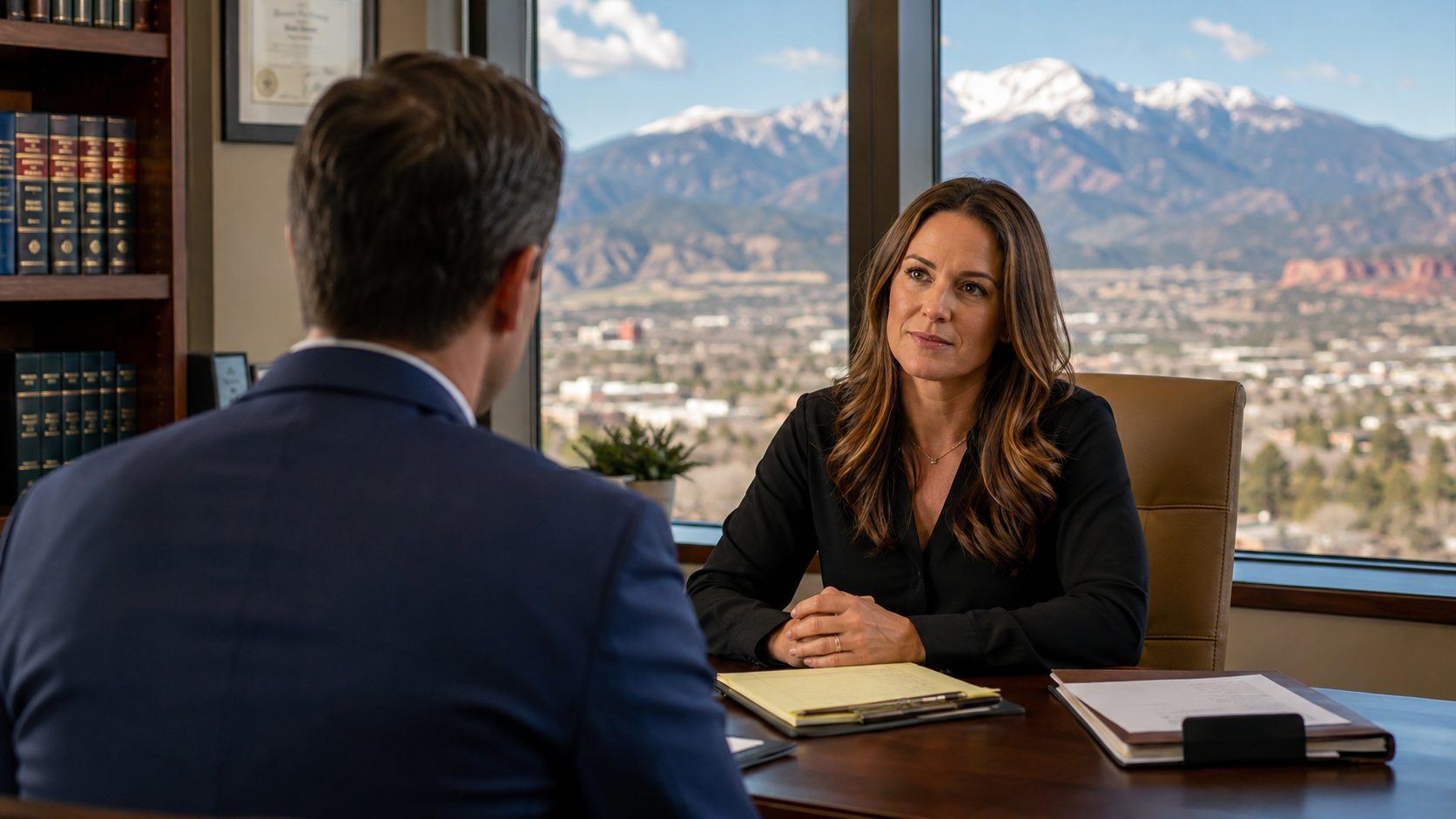
Divorce in Colorado is formally called a dissolution of marriage. Colorado Springs cases are filed in El Paso County District Court, part of Colorado's 4th Judicial District, so local procedures and timing shape a case from the first filing forward.
Three Requirements Apply Before A Court Can Enter A Decree:
One spouse must have been domiciled in Colorado for at least 91 days before the case starts
The court must find the marriage is irretrievably broken
At least 91 days must pass after the court acquires jurisdiction over the responding spouse.
This Page Explains The Divorce Process:
What an uncontested divorce looks like when spouses agree
What changes in a contested case when they do not agree
How courts divide marital assets and allocate debt under Colorado's equitable division rules, which call for a fair division rather than an automatically equal one
It also covers parenting time, spousal maintenance, costs, common mistakes, and how preparation affects your financial interests
You will also find what changed under Colorado's 2025 and 2026 family law legislation, including the March 1, 2026 child support guideline updates and the May 27, 2026 domestic violence changes. This is general information about Colorado law, not legal advice, and reading it does not create an attorney-client relationship. Reviewed for legal accuracy July 2026.
Reviewed for legal accuracy July 2026. Colorado's child support guidelines changed on March 1, 2026, and its domestic violence provisions changed on May 27, 2026. Both changes are reflected below.
ON THIS PAGE
- Colorado Divorce At A Glance
- What Divorce Means In Colorado
- Who Can File In El Paso County
- The 91-Day Waiting Period And Realistic Timelines
- How A Colorado Springs Divorce Case Moves
- How Colorado Divides Property And Debt
- Spousal Maintenance Under The Advisory Guidelines
- Child Support After The March 2026 Overhaul
- Parenting Time And Decision-Making
- Court Costs And What Drives The Total Cost
- Mistakes That Cost Clients The Most
- How To Prepare Before Your First Meeting
- Frequently Asked Questions
- Sources
COLORADO DIVORCE AT A GLANCE
Question | Answer | Authority |
What is divorce called? | Dissolution of marriage | C.R.S. § 14-10-106 |
Is fault required? | No. The court must find the marriage is irretrievably broken. | § 14-10-106(1)(a)(II) |
Residency requirement | One party domiciled in Colorado for 91 days before the proceeding starts | § 14-10-106(1)(a)(I) |
Minimum wait for a decree | 91 days after the court gets jurisdiction over the respondent | § 14-10-106(1)(a)(III) |
Which court | District court. For Colorado Springs, El Paso County District Court, 4th Judicial District | § 14-10-106(1)(a) |
Property system | Equitable division. Colorado is not a community property state. | § 14-10-113 |
Maintenance guideline range | Marriage of at least 3 years and combined annual adjusted gross income of $240,000 or less | § 14-10-114(3)(b) |
Child support schedule ceiling | $40,000 combined monthly adjusted gross income, raised from $30,000 on March 1, 2026 | § 14-10-115(7)(b) |
When child support ends | Age 19, with limited exceptions | § 14-10-115(13) |
Financial disclosure deadline | 42 days after service of the petition | C.R.C.P. 16.2(e)(2) |
Initial status conference | No later than 42 days from filing the petition | C.R.C.P. 16.2(c)(1)(E) |
Reopening for hidden assets | Court keeps jurisdiction 5 years after the decree | C.R.C.P. 16.2(e)(10) |
WHAT DIVORCE MEANS IN COLORADO
A decree of dissolution ends the marriage and resolves the issues within the court's authority. Those issues include division of property and debt, spousal maintenance, allocation of parental responsibilities, child support, and restoration of a prior name.
The court can defer entry of orders on parental responsibilities, support, maintenance, or property until after the dissolution decree, but only if it finds that deferral is in the best interests of the parties. Colorado courts treat that split, often called bifurcation, as reserved for exceptional cases.
Dissolution, Legal Separation, And Invalidity
Colorado offers three related proceedings. A dissolution ends the marriage. A legal separation divides property and sets support but leaves the parties married. A declaration of invalidity, sometimes called annulment, treats the marriage as never validly formed.
If one spouse asks for legal separation rather than dissolution, the court must grant it in that form unless the other spouse objects. No earlier than 182 days after a decree of legal separation is entered, either party may move to convert it to a decree of dissolution, and on proof that notice was mailed to the other party, the court must do so.
Common Law Marriage
Colorado is one of a small number of states that still recognizes common law marriage. That matters because a common law marriage has to be dissolved through the same court process as a ceremonial one. Simply separating does not end it.
In Hogsett v. Neale, 478 P.3d 713 (Colo. 2021), the Colorado Supreme Court replaced the older mechanical checklist with a totality of the circumstances test. A common law marriage requires mutual agreement to enter the legal and social institution of marriage, followed by conduct manifesting that agreement, with the core question being whether the parties intended to share a life as spouses. A statutory minimum age applies to common law marriages entered on or after September 1, 2006.
WHO CAN FILE IN EL PASO COUNTY
Three separate questions decide whether a Colorado Springs court can hear your case: whether Colorado has authority over the marriage, whether El Paso County is the right county, and whether Colorado can decide issues about your children.
Choosing a Colorado Springs divorce attorney who regularly appears in the El Paso County Combined Courts matters here. Familiarity with the local rules, division-specific procedures, and scheduling practices helps avoid filing errors that cost time early in a case.
The 91-Day Domicile Requirement
The court cannot enter a decree unless it finds that one of the parties has been domiciled in Colorado for 91 days immediately before the proceeding began. Domicile means more than physical presence. It means Colorado is the person's legal home.
This point comes up often in a military town. Colorado courts have held that presence in the state solely as a member of the armed forces is not by itself enough to confer jurisdiction. Still, a service member can establish Colorado domicile after being stationed here for the statutory period. Voter registration, a Colorado driver's license, vehicle registration, and intent to remain all bear on the question.
Venue And The 4th Judicial District
Domestic relations cases go to district court, not county court. El Paso County sits in Colorado's 4th Judicial District, and the courthouse is the El Paso County Judicial Building at 270 South Tejon Street in Colorado Springs, with the clerk's office in Room S101.
El Paso County offers e-filing for non-attorneys in divorce, legal separation, and custody cases, and runs a free on-site childcare program called Court Care for parents who have court business. Current hours, division schedules, and local forms are posted on the Colorado Judicial Branch page for El Paso County.
Jurisdiction Over Children
Authority to end a marriage is not the same as authority to decide parenting issues. Colorado allocates parental responsibilities under § 14-10-123, and jurisdiction over the children is governed by the Uniform Child-custody Jurisdiction and Enforcement Act rather than by the divorce residency rule.
The practical consequence is that a Colorado court may be able to dissolve the marriage while a different state remains the proper forum for the parenting decisions, or the reverse. If your family has moved recently, this should be one of the first things reviewed.
THE 91-DAY WAITING PERIOD AND REALISTIC TIMELINES
The statute requires that 91 days or more have elapsed since the court acquired jurisdiction over the respondent. That clock starts when the respondent is served under Rule 4 of the Colorado Rules of Civil Procedure, joins as a co-petitioner, or otherwise enters an appearance. It does not start on the day the petition is filed unless the parties file together.
The 91-day period is a floor, not a target, and it cannot be shortened by agreement. Colorado does not require spouses to live separately before or during the case.
How long a case actually takes depends on how much is disputed and how quickly both sides produce records. Colorado Springs divorce cases range from fully uncontested filings to high-asset disputes:
- Fastest realistic outcome: a little over 91 days, where the parties file as co-petitioners, exchange complete disclosures, sign a full agreement, and qualify for a decree on affidavit without a hearing under § 14-10-120.3.
- Agreed cases with normal paperwork friction: commonly a few months beyond the minimum, driven by disclosure gaps, appraisals, and court scheduling. Mediation and negotiated resolution generally reduce both time and cost compared with litigation.
- Contested cases: substantially longer, because the case has to move through temporary orders, discovery, expert work, mediation, and a contested permanent orders hearing. Most divorce cases still settle without a trial.
Anyone quoting you a firm finish date before seeing the asset picture and the level of conflict is guessing.
HOW A COLORADO SPRINGS DIVORCE CASE MOVES
Colorado runs domestic relations cases under Rule 16.2, which puts the court in an active case management role and imposes an affirmative duty of disclosure on both parties. The sequence below is the standard path.
Filing And Service
A case begins with a petition for dissolution of marriage. One spouse may file as petitioner, or both may file jointly as co-petitioners, which removes the need for formal service. If one spouse files alone, the other must be served in a legally valid way, and Colorado does not allow you to serve your own spouse personally.
If you have been served, do not ignore it. A response deadline applies, and not participating can result in orders entered without your input.
The Automatic Temporary Injunction
This is the provision most people do not know exists, and violating it causes real damage. Under § 14-10-107(4)(b), an automatic temporary injunction takes effect against both parties and stays in effect until the final decree is entered, the petition is dismissed, or the court orders otherwise. It binds the petitioner on filing, and the respondent on personal service or waiver of service, and its terms are printed on the summons and petition.
The injunction does four things:
- Restrains both parties from transferring, encumbering, concealing, or disposing of any marital property without the other party's consent or a court order, except in the usual course of business or for the necessities of life. It also requires each party to notify the other of proposed extraordinary expenditures and to account to the court for extraordinary expenditures made after it takes effect.
- Enjoins both parties from molesting or disturbing the peace of the other party.
- Restrains both parties from removing a child of the parties from the state without the other party's consent or a court order.
- Restrains both parties from canceling, modifying, terminating, or letting lapse any health, homeowner's or renter's, or automobile insurance covering either party or the minor children, or any life insurance naming either party or the minor children as beneficiary, without at least 14 days' advance notice and the other party's written consent or a court order.
Emptying an account, refinancing a house, or dropping a spouse from health coverage after a case is filed is not a neutral act. Either party can also ask the court for further temporary orders or an expanded injunction under § 14-10-108.
Initial Status Conference
The petitioner is responsible for scheduling the initial status conference, and scheduling is not delayed to accomplish service. The conference, or a filed Stipulated Case Management Plan, must happen no later than 42 days from the filing of the petition.
The conference is informal and may be conducted by a family court facilitator. Parties who file an affidavit for entry of decree with all required documents beforehand are excused from attending, and where both sides have counsel, a stipulated plan plus disclosures and a certificate of compliance can substitute for appearing.
Financial Disclosures Under Rule 16.2
Both parties owe each other and the court a duty of full and honest disclosure of all facts that materially affect their rights and those of the children. The duty is affirmative, meaning you disclose without waiting to be asked.
Within 42 days after service of the petition, or of a post-decree motion involving financial issues, each party must provide the mandatory disclosures and a completed Sworn Financial Statement with supporting schedules where applicable. The parties are expected to exchange these by the time of the initial status conference to the extent reasonably possible.
The Sworn Financial Statement, supporting schedules, and child support worksheets are filed with the court. The other mandatory disclosure documents are not. A certificate of compliance accompanies the disclosures and certifies that they are complete and correct. Failure to comply can result in sanctions, and the duty to supplement continues as circumstances change. A 2024 rule change also allows parties in some cases to agree to limited financial disclosures, with either party able to withdraw that consent and trigger full disclosure.
Temporary Orders
Temporary orders address what cannot wait for the end of the case: parenting time, child support, maintenance, who stays in the home, who pays which bills, attorney fees, and safety conditions. Hearings on temporary orders are held as soon as possible, and before the hearing the parties must certify on the record that they conferred and tried in good faith to resolve the issues.
A temporary maintenance determination does not prejudice either party at permanent orders, and the guideline maintenance term does not apply to temporary awards.
Mediation
Most El Paso County divorce cases go through mediation before a contested final hearing, which gives both spouses a structured chance to negotiate a settlement rather than have a judge decide. Issues that mediation does not resolve move on to a contested permanent orders hearing. The court may order mediation under § 13-22-311 to help the parties build or modify a parenting plan and may allocate the cost between them.
Mediation works best when both sides already have complete financial information. Mediating before disclosures are exchanged usually just produces a second mediation.
Permanent Orders
Cases end by full agreement, partial agreement, a contested permanent orders hearing, or default. Under Rule 16.2, witness lists are due no later than 63 days before a contested hearing, discovery must be completed no later than 28 days before it, expert reports are due 56 days before with rebuttals 21 days later, and the trial management certificate and exhibit exchange happen at least 7 days out.
A decree of dissolution is final when entered, subject to appeal. An appeal that does not challenge the finding that the marriage is irretrievably broken does not delay finality of the provision dissolving the marriage, so either party may remarry while the appeal is pending.
HOW COLORADO DIVIDES PROPERTY AND DEBT
Colorado is an equitable division state, not a community property state. The court sets apart each spouse's separate property and divides the marital property, without regard to marital misconduct, in the proportions it deems just. Division of property is mandatory, unlike maintenance, which is discretionary.
Equitable does not mean equal. Colorado courts have said repeatedly that the mandate to divide property equitably does not require equality, and there is no mathematical formula. The statute directs the court to consider each spouse's contribution to acquiring marital property including as a homemaker, the value of property set apart to each, the economic circumstances of each at the time the division becomes effective including the desirability of awarding the family home to the spouse with whom the children live most of the time, and any increase, decrease, or depletion in separate property during the marriage.
Marital Versus Separate Property
Marital property means all property acquired by either spouse after the marriage, with four exceptions: property acquired by gift, bequest, devise, or descent; property acquired in exchange for premarital property or for gifted or inherited property; property acquired after a decree of legal separation; and property excluded by valid agreement.
Everything acquired after the marriage and before a legal separation decree is presumed marital, no matter whose name is on the title. To overcome the presumption, a spouse has to trace the asset back through a series of exchanges to an original separate asset. Tracing failures are one of the most common reasons a separate property claim collapses.
Two traps worth naming. Gifts from one spouse to the other during the marriage are presumed marital, not separate, and that presumption can only be rebutted by clear and convincing evidence. And an oral agreement to keep retirement accounts or inheritances separate is not enough, because marital agreements must be in writing and signed by both parties.
Increases In Separate Property
Separate property stays separate, but any increase in its value during the marriage is marital property subject to division. A house one spouse owned before the marriage generally remains that spouse's, while the appreciation during the marriage does not.
Property is valued as of the date of the decree, or as of the date of the property hearing if that hearing comes first.
What Is Not Divisible
Some things people expect to be divided are not property under Colorado law. A professional degree earned during the marriage is not property, though a spouse's contribution to it can be weighed in the property division and in maintenance. A life insurance policy with no cash surrender value is not property. An expected inheritance from a living person, and an interest under a revocable or amendable third-party instrument such as a revocable trust or will, cannot be treated as property or even as an economic circumstance.
For military families, vested military retirement pay accrued during the marriage is marital property subject to division, but federal law excludes veterans' disability retirement benefits from division. That distinction changes the numbers significantly and needs to be handled correctly the first time, because a court that fails to divide a pension at the decree can lose the authority to do it later.
On the debt side, all debt acquired during the marriage is marital debt. Classifying a debt as marital does not prevent the court from assigning responsibility for paying it to the spouse who incurred it. Ordinary marital fault is not considered, but economic fault, such as dissipating assets in contemplation of divorce, can be.
The Five-Year Reopening Rule
If a party's disclosures contain misstatements or omissions, the court retains jurisdiction for five years after the final decree to allocate material assets or liabilities whose omission materially affected the division. Rule 60 does not bar that motion.
This is the strongest reason to insist on complete disclosure rather than accepting a summary. It cuts both ways, and it does not apply to maintenance or to income used to determine maintenance.
SPOUSAL MAINTENANCE UNDER THE ADVISORY GUIDELINES
Maintenance is what Colorado calls alimony or spousal support. It is awarded at permanent orders on the request of either party, in an amount and for a term that is fair and equitable to both, and it is decided without regard to marital misconduct.
The single most misunderstood point is this: the guidelines are advisory, not presumptive. The statute says so expressly, and the Court of Appeals has confirmed that the legislature intended them as a starting point rather than a cap or restriction on the court's determination.
The Threshold Findings
Before granting or denying maintenance, the court must make findings on each party's gross income, the marital property apportioned to each, the financial resources of each including income from separate or marital property, reasonable financial need as established during the marriage, and whether the award would be deductible to the payor and taxable to the recipient.
The court may award maintenance only if it finds that the spouse seeking it lacks sufficient property, including the marital property apportioned to that spouse, to provide for reasonable needs and is unable to support themselves through appropriate employment, or is the custodian of a child whose condition makes outside employment inappropriate.
The Guideline Amount
The guideline calculation applies when the marriage lasted at least three years and the parties' combined annual adjusted gross income does not exceed $240,000.
The base figure is 40 percent of the parties' combined monthly adjusted gross income, minus the lower earning party's monthly adjusted gross income. If the result is negative, the guideline amount is zero.
That base applies where the award is deductible to the payor and taxable to the recipient. Where it is not, and for most awards entered since the 2017 federal Tax Cuts and Jobs Act took effect it is not, the statute reduces the figure:
- Combined monthly adjusted gross income of $10,000 or less: 80 percent of the base figure.
- Combined monthly adjusted gross income of more than $10,000 but not more than $20,000: 75 percent of the base figure.
A worked example. Assume a higher earner at $6,000 per month and a lower earner at $3,000 per month, so combined monthly adjusted gross income is $9,000. Forty percent of $9,000 is $3,600. Subtracting the lower earner's $3,000 leaves $600. Because the award is not deductible and combined income is under $10,000, the guideline amount is 80 percent of $600, or $480 per month.
The Guideline Term
For marriages of at least three years but not more than 20 years, the statute contains a month-by-month table setting the advisory term as a percentage of the length of the marriage. The percentage starts at 31 percent for a 36-month marriage and rises to 50 percent at 150 months, where it stays.
Length of marriage | Percentage | Advisory maintenance term |
36 months (3 years) | 31.00% | 11 months |
60 months (5 years) | 35.00% | 21 months |
120 months (10 years) | 45.00% | 54 months |
180 months (15 years) | 50.00% | 90 months |
240 months (20 years) | 50.00% | 120 months |
Duration of marriage is measured in whole months from the first day of the month following the marriage until the date of the decree, or the date of the property hearing if that comes first.
Beyond 20 years, the court may set a specific term or an indefinite one, but it cannot order a term shorter than the 20-year guideline term without specific findings supporting the reduction. For marriages under three years, maintenance is still available where the property division alone cannot achieve an equitable result.
Above The Guideline Income Cap
When combined annual adjusted gross income exceeds $240,000, the guideline amount formula does not apply at all. The court instead works through the statutory factors, though it may still consider the guideline term.
Those factors include the financial resources of each spouse, the lifestyle during the marriage, the property distribution, both parties' employability, whether a party historically earned more or less than at permanent orders, the duration of the marriage, the age and health of the parties, significant contributions to the other spouse's education or career, and tax treatment.
The 2025 Amendments
Two changes from the 2025 legislative session matter here. First, the statute now lists domestic violence, coercive control, economic abuse, litigation abuse, emotional abuse, physical abuse, and unlawful sexual behavior against the other spouse as a factor affecting the amount and term of maintenance. Second, the rule on imputing potential income to a voluntarily unemployed or underemployed party was narrowed, so no potential income is imputed to a party who is physically or mentally incapacitated, is caring for a child under 24 months for whom the parties owe a joint legal responsibility, or is an incarcerated parent sentenced to 180 days or more.
Note also that overtime counts as gross income only if the employer requires it as a condition of employment, and income from additional jobs that push a party beyond full-time work is excluded. In a city with as much shift work and moonlighting as Colorado Springs, that distinction changes real numbers.
CHILD SUPPORT AFTER THE MARCH 2026 OVERHAUL
On March 1, 2026, Colorado's child support guidelines changed more than they had in over a decade. House Bill 25-1159 was signed on May 31, 2025, and the amendments to subsections (3), (7), and (8) of § 14-10-115 took effect on March 1, 2026. Any page or calculator still describing the old rules is out of date.
What Changed On March 1, 2026
- The 93-overnight cliff is gone. "Shared physical care" previously required each parent to have more than 92 overnights per year. It now means each parent has the children for at least one overnight per year, so parenting time credit begins with the first overnight.
- The schedule ceiling rose from $30,000 to $40,000 in combined monthly adjusted gross income, and the entire schedule of basic child support obligations was rewritten.
- The 1.5 multiplier is gone. The old approach multiplied the basic obligation by 1.5 in shared care cases. A parenting time credit table replaced that.
- A self-support reserve was introduced, defined as the state hourly minimum wage multiplied by 29 hours per week, multiplied by 50 weeks, divided by 12 months.
- "Split physical care" was redefined as each parent having physical care of at least one child who resides with that parent more than 50 percent of the time.
The new rules apply to child support orders entered or modified on or after March 1, 2026. The controlling date is the date of the support order, not the filing date of the case.
The Parenting Time Credit
The calculation now runs in a straight line. The basic obligation comes from the schedule based on combined adjusted gross income and the number of children, it is divided between the parents in proportion to each parent's adjusted gross income, and then each parent receives a parenting time credit equal to the total basic obligation multiplied by that parent's credit percentage from the statutory table. The parent owing the greater amount pays the difference.
The table runs from 0 to 365 overnights. A few reference points show why the old cliff mattered so much and why it no longer does:
Overnights per year | Parenting time credit |
0 | 0.00% |
1 | 0.07% |
92 | 13.19% |
93 | 13.45% |
182.5 | 50.00% |
274 | 87.06% |
365 | 100.00% |
Under the old system, moving from 92 to 93 overnights switched the case to an entirely different worksheet and often changed the number sharply. Now the difference between 92 and 93 overnights is about a quarter of one percent. The incentive to fight over a single night for financial reasons is largely gone.
In no case may a parent with shared physical care owe more than that same parent would owe with no overnights. Where the parties have different numbers of overnights with two or more children, the overnights are added together and divided by the number of children in the worksheet.
The Self-Support Reserve And Low-Income Adjustment
Where the paying parent's monthly adjusted gross income is $650 or less, the minimum order is $10 per month regardless of the number of children. Where it is more than $650 but at or below the self-support reserve, the basic obligation is reduced to $50 per month for one child, $70 for two, $90 for three, $110 for four, $130 for five, and $150 for six or more.
Where the paying parent's income is above the self-support reserve, the reserve amount is deducted from that parent's adjusted gross income. A percentage of the difference is then applied: 80 percent for one child, 85 percent for two, 89 percent for three, 92 percent for four, 94 percent for five, and 95 percent for six or more, compared against the schedule amount.
Above the top of the schedule, the judge has discretion, but the presumptive basic obligation cannot be less than it would be at the highest income level in the schedule.
Add-Ons And Extraordinary Expenses
On top of the basic obligation, the calculation adds work-related and education-related childcare costs, health insurance premiums for the children, extraordinary medical expenses, and other extraordinary adjustments, allocated in proportion to each parent's income.
Extraordinary medical expenses are uninsured costs, including copays and deductibles, above $250 per child per calendar year. The 2026 amendments tightened the reimbursement process: ongoing expenses may be built into the worksheet only if they are consistent and expected to continue, and absent extraordinary circumstances, failing to give the other party proof of an expense by July 1 of the following year waives reimbursement. If the other party does not respond or reach a payment arrangement within 49 days of the request, the requesting party may move for judgment.
The amendments also added express factors and conditions for allocating the income tax dependency exemption, along with a remedy where a party claims a child in violation of a court order.
When Child Support Ends
For orders entered on or after July 1, 1997, support terminates automatically without either party filing a motion when the last or only child turns 19. There are three exceptions: the parties agreed otherwise in a written stipulation, the child is mentally or physically disabled and the court orders support to continue, or the child is still in high school or an equivalent program, in which case support runs to the end of the month following graduation but not past age 21.
A 2026 addition closed a gap here: a concurrent enrollment program does not count as an equivalent program, and a child in one is emancipated once the child completes the local education provider's minimum graduation requirements.
PARENTING TIME AND DECISION-MAKING
Colorado does not use the word custody. It uses allocation of parental responsibilities, which covers parenting time (the schedule) and decision-making responsibility (authority over major decisions such as education, medical care, and religion).
Best Interests Of The Child
The court allocates parental responsibilities in accordance with the best interests of the child, giving paramount consideration to the child's safety and the child's physical, mental, and emotional conditions and needs. The statute lists the factors, including the child's relationships with parents, siblings, and others who significantly affect the child's interests, and reports related to domestic violence submitted by a child and family investigator, a parental responsibilities evaluator, or the child's legal representative.
The court is not to consider conduct of a party that does not affect that party's relationship to the child, and it may not presume that either parent is better able to serve the child's best interests because of that parent's sex. In contested hearings on final orders, the court must make findings on the record about the factors it considered and why its allocation is in the child's best interests.
The General Assembly has also declared that in most circumstances it is in everyone's interest to encourage frequent and continuing contact between each parent and the children, while acknowledging that co-parenting is not appropriate in all cases.
Under § 14-10-123.7, the court may also order a parent whose child is under 18 to attend a parental education program covering the impact of separation and divorce on children. The statute is permissive rather than mandatory, but most Colorado judicial districts expect proof of completion before entering final orders, so treat it as a step to schedule early rather than a formality.
The 2026 Domestic Violence Findings Requirement
House Bill 26-1309, signed on May 27, 2026 and effective that same day, changed how El Paso County judges must handle abuse allegations in parenting cases. It is recent enough that most published guidance has not caught up.
Under the act, where evidence is submitted about whether a party committed domestic violence, child abuse or neglect, or sexual assault that resulted in the conception of a child, the court may consider any relevant and admissible evidence. It must make findings on the record, by a preponderance of the evidence, on whether the party committed those acts. If the court so finds, the act sets out the considerations the court must work through in deciding decision-making responsibility and parenting time, including specific written findings where it nonetheless allocates parenting time or decision-making authority to that party.
The act also clarified that for purposes of the Uniform Dissolution of Marriage Act, domestic violence includes specified acts or threatened acts of harm or property damage against a family or household member, and that the conduct is domestic violence regardless of whether it amounts to a criminal offense. A person's protective behaviors do not constitute domestic violence. It further changed who may provide treatment before a court orders a party to take steps to repair a relationship with a child, now requiring a licensed mental health professional with a master's or doctoral degree and specialized training in domestic violence and child abuse.
Separately, coercive control is defined in the parenting statutes as a pattern of threatening, humiliating, or intimidating actions, including assaults or other abuse, used to harm, punish, or frighten someone. And where a court orders unsupervised parenting time despite information or an accusation of domestic violence, child abuse, child sexual abuse, child emotional abuse, or coercive control, it must state on the record why unsupervised time is in the child's best interests.
What A Parenting Plan Should Cover
A vague plan generates return trips to court. A workable one addresses weekday and weekend schedules, holidays and school breaks, transportation and exchange locations, communication between parents and with the children, travel and passports, extracurricular activities and who pays for them, decision-making on education and medical care, access to records, notice requirements for relocation, and a dispute resolution step before either parent files a motion.
For military families, a parenting plan often needs deployment-specific terms as well, including how exchanges, parenting time, and communication with the children will work during a deployment or an extended training absence, and how the schedule resumes on return.
Keep written communication calm and factual. Judges routinely read texts, emails, and parenting app messages. Write as though the court will see it, because it often does.
COURT COSTS AND WHAT DRIVES THE TOTAL COST
Court filing fees are a small and predictable part of the cost. Under the Colorado Judicial Branch fee schedule, the fee to file a petition for dissolution of marriage is $260, and the fee to file a response is $146. An e-filing surcharge applies to electronic submissions. Fees change, so confirm the current amounts with the clerk of court or on the Colorado Judicial Branch forms page for El Paso County before you file.
Colorado offers a fee waiver process for filers who cannot afford the filing fee. Ask the clerk about the current forms and income thresholds.
What actually determines the total is not the fee schedule. It is how many issues are genuinely disputed, how complete the financial records are, whether experts are needed for a business valuation, real estate appraisal, pension valuation, or parenting evaluation, and how many court appearances the disagreements require. We do not publish flat cost estimates for contested divorces, because a number produced before anyone has seen the asset picture is not information.
Two things reliably lower the cost. Produce complete disclosures the first time, and decide in advance which issues you actually need to win.
MISTAKES THAT COST CLIENTS THE MOST
- Violating the automatic temporary injunction. Moving money, refinancing, selling property, or dropping insurance after filing can trigger sanctions and damage credibility on every other issue.
- Incomplete disclosure. Beyond sanctions, the court keeps jurisdiction for five years to reallocate assets that were misstated or omitted. A shortcut now can reopen the case later.
- Assuming an asset is separate without tracing it. The presumption runs the other way. Without a documented chain of exchanges, a premarital or inherited asset can end up in the marital pot.
- Relying on an oral side agreement. A marital agreement excluding retirement accounts or inheritances has to be in writing and signed.
- Treating the maintenance guideline as the answer. It is advisory. Both an above-guideline and a below-guideline result are available with proper findings and evidence.
- Negotiating child support on the old rules. If your order will be entered or modified after March 1, 2026, the 93-overnight math no longer applies. Agreements built on the old worksheets can be materially wrong.
- Signing a vague parenting plan to end the conflict. Ambiguity is where the next two years of motions come from.
- Waiving maintenance while unrepresented without understanding the guidelines. Where a case falls within the guidelines and a party has no attorney or licensed legal paraprofessional, the court is not to approve a waiver or an off-guideline agreement unless that party indicates awareness of the guidelines.
- Accessing accounts you are not authorized to use. Guessing a password or reading a spouse's email creates a new legal problem. If you are locked out of records, raise it through the disclosure process.
HOW TO PREPARE BEFORE YOUR FIRST MEETING
You do not need to have answers before your first consultation. You do need to know which documents exist and which are missing, because the disclosure clock starts running 42 days after service and Colorado's disclosure duty is affirmative.
Bring or gather what you can:
- Recent pay stubs and the last two to three years of tax returns, including business returns and schedules if either spouse is self-employed.
- Bank, credit card, and investment account statements.
- Retirement and pension statements, including military retirement records and any Survivor Benefit Plan documents.
- Mortgage statements, deeds, vehicle titles, and loan documents.
- Insurance policies for health, home or renters, auto, and life, with beneficiary designations.
- Documents supporting any separate property claim, such as premarital account statements, gift or inheritance records, and closing documents showing the source of funds.
- For children, school calendars, childcare invoices, health insurance and medical cost records, activity schedules, and any written parenting agreements.
- A short written timeline of the issues you are most worried about, and any safety concerns.
If safety is a factor, say so at the outset. Domestic violence, coercive control, threats, substance abuse, and financial control affect temporary orders, parenting time, exchange arrangements, and now the findings a court is required to make. It changes the sequence of what needs to happen first.
Moran, Allen & Associates offers initial consultations for El Paso County divorce and parenting matters. A useful first meeting focuses on your immediate deadlines, the records that support your position, and the two or three issues that will actually decide the outcome. It is also the time to ask whether the lawyer regularly handles cases like yours, including military, business-ownership, or high-conflict parenting matters.
FREQUENTLY ASKED QUESTIONS
How Fast Can I Get Divorced In Colorado?
At least 91 days must pass after the court acquires jurisdiction over the responding spouse before a decree can be entered. That period cannot be waived even if both spouses agree on everything. The fastest realistic outcome is a little over 91 days for a co-petitioned case with complete disclosures and a signed agreement. Contested cases take considerably longer.
Do I Need To Prove My Spouse Did Something Wrong?
No. Colorado requires only a finding that the marriage is irretrievably broken. Marital misconduct is expressly excluded from both the property division and the maintenance decision. Conduct still matters where it bears on a child's safety or amounts to economic fault such as dissipating assets.
How Long Do I Have To Live In Colorado Before I Can File?
One of the parties must have been domiciled in Colorado for 91 days immediately before the proceeding begins. Jurisdiction over parenting issues is decided separately under the Uniform Child-custody Jurisdiction and Enforcement Act, so a recent move can put the two questions in different states.
Does Colorado Split Everything 50/50?
No. Colorado divides marital property equitably, which means a division the court finds just rather than an automatically equal one, and it is not a community property state. The court sets apart each spouse's separate property first, then divides the marital estate in the proportions it finds just after weighing the statutory factors.
Is My Inheritance Or Premarital Home Safe In A Colorado Divorce?
The asset itself is generally separate property, but any increase in its value during the marriage is marital property subject to division. You also have to be able to trace it. Everything acquired after the marriage is presumed marital regardless of whose name is on it, and commingling can defeat a separate property claim.
How Is Spousal Maintenance Calculated In Colorado?
Where the marriage lasted at least three years and combined annual adjusted gross income is $240,000 or less, the guideline amount is 40 percent of combined monthly adjusted gross income minus the lower earner's monthly income, reduced to 80 percent of that figure where combined monthly income is $10,000 or less, or 75 percent where it is between $10,000 and $20,000, when the award is not deductible to the payor. The term comes from a statutory table running from 11 months for a three-year marriage to 120 months for a 20-year marriage. The guidelines are advisory, not presumptive.
Did Colorado Child Support Change In 2026?
Yes. Effective March 1, 2026, House Bill 25-1159 eliminated the 93-overnight threshold so that parenting time credit begins with the first overnight, raised the schedule ceiling from $30,000 to $40,000 in combined monthly adjusted gross income, rewrote the schedule of basic child support obligations, removed the 1.5 shared care multiplier in favor of a parenting time credit table, and added a self-support reserve. The new rules apply to orders entered or modified on or after that date.
Does The 93-Overnight Rule Still Matter?
Not for orders entered or modified on or after March 1, 2026. Shared physical care now requires only one overnight per year, and the credit scales smoothly, so the difference between 92 and 93 overnights is roughly a quarter of one percent. Overnights still matter a great deal to the overall number, just not at that single threshold.
When Does Child Support End In Colorado?
Support terminates automatically when the last or only child turns 19, without either party filing a motion, unless the parties stipulated otherwise in writing, the child is mentally or physically disabled and the court extends support, or the child is still in high school, in which case support runs to the end of the month following graduation but not past age 21.
What Happens Automatically When A Divorce Is Filed?
An automatic temporary injunction takes effect. It restrains both parties from disposing of marital property outside the usual course of business or the necessities of life, from disturbing the other party's peace, from removing a child from the state without consent or a court order, and from canceling or letting lapse health, home, auto, or life insurance covering either party or the children without 14 days' notice and written consent or a court order.
Can A Colorado Divorce Be Reopened After The Decree?
The decree itself is final when entered. Support, maintenance, and parenting orders can be modified later on a proper showing, but the property division is treated as final and is much harder to disturb. There is one specific route: if disclosures contained misstatements or omissions, the court keeps jurisdiction for five years after the final decree to allocate material assets or liabilities whose omission materially affected the division. That provision does not reach maintenance.
Where Do I File For Divorce In Colorado Springs?
In El Paso County District Court, part of the 4th Judicial District, at the El Paso County Judicial Building, 270 South Tejon Street, Colorado Springs, with the clerk's office in Room S101. Domestic relations cases go to district court rather than county court, and El Paso County offers e-filing for non-attorneys in divorce, legal separation, and custody cases.
Should I File For Legal Separation Instead?
A legal separation divides property and sets support but leaves you married, which some people choose for insurance, religious, or benefit reasons. If one party requests legal separation, the court grants it in that form unless the other objects. No earlier than 182 days after the decree of legal separation, either party may move to convert it to a dissolution, and the court must do so on proof that notice was mailed. The Colorado Judicial Branch publishes instructions for changing a legal separation to a divorce.
I Am Stationed At Fort Carson Or Peterson. Can I Divorce In Colorado?
Often yes. Colorado Springs has a large military community, and many local divorce cases involve Fort Carson, Peterson Space Force Base, or Schriever Space Force Base. Colorado courts have held that being present in the state solely as a service member does not by itself establish jurisdiction. Still, a service member can establish Colorado domicile after being stationed here for the statutory period.
A military divorce raises added issues under both Colorado law and federal statutes, including the treatment of retirement pay and the exclusion of veterans' disability retirement benefits from division. It may also involve protections under the Servicemembers Civil Relief Act, which can allow a stay of proceedings and affect timing.
Do I Have To Go To Court?
Not necessarily. Where the parties reach a complete agreement and file the required documents, Colorado allows a decree on affidavit without an appearance under § 14-10-120.3, and filing those documents before the initial status conference excuses attendance at that conference. Contested issues do require hearings.

SOURCES
Every legal statement on this page was checked against the primary sources below.
Colorado Statutes
C.R.S. § 14-10-106, Dissolution of marriage and legal separation, covering the 91-day domicile requirement, irretrievable breakdown, the 91-day waiting period, bifurcation, and legal separation on request.
C.R.S. § 14-10-107, Commencement, pleadings, and automatic temporary injunction.
C.R.S. § 14-10-113, Disposition of property, covering equitable division, marital and separate property, valuation, and interspousal gifts.
C.R.S. § 14-10-114, Spousal maintenance and advisory guidelines, covering the threshold findings, the guideline amount and term table, the $240,000 ceiling, the statutory factors, and the definitions.
C.R.S. § 14-10-115, Child support guidelines, covering the schedule, the parenting time table, the self-support reserve, the low-income adjustment, extraordinary medical expenses, and emancipation.
C.R.S. § 14-10-120, Decree, covering finality, remarriage pending appeal, and the 182-day conversion of a legal separation.
C.R.S. § 14-10-123.7, Parental education, under which a court may order a parental education program.
C.R.S. § 14-10-124, Best interests of the child, covering allocation of parental responsibilities, the paramount consideration of child safety, coercive control, and the unsupervised parenting time findings.
Colorado Uniform Dissolution of Marriage Act, Article 10 in full, including § 14-10-108 temporary orders, § 14-10-112 separation agreements, § 14-10-119 attorney fees, § 14-10-120.3 decree upon affidavit, § 14-10-122 modification, and § 14-10-123 allocation of parental responsibilities.
Colorado Legislation
House Bill 25-1159, Child Support Commission Recommendations, signed May 31, 2025, Session Laws chapter 334.
Session Laws of Colorado 2025, chapter 334, full text, containing the new schedule of basic child support obligations, the parenting time table, and the section 13 effective date providing that § 14-10-115(3), (7), and (8) take effect March 1, 2026.
House Bill 26-1309, Abuse in Cases of Separation, signed May 27, 2026, Session Laws chapter 163, effective May 27, 2026.
Court Rules And Colorado Judicial Branch Resources
Colorado Rule of Civil Procedure 16.2, Court Facilitated Management of Domestic Relations Cases, covering the 42-day initial status conference, the 42-day disclosure deadline, the Sworn Financial Statement, the certificate of compliance, the discovery and expert deadlines, and the five-year reopening provision.
Colorado Judicial Branch, El Paso County, for the 4th Judicial District, courthouse location, clerk's office, e-filing, and Court Care.
Colorado Judicial Branch, Forms for El Paso County.
Colorado Judicial Branch, Change a Legal Separation to a Divorce.
Colorado Case Law
Hogsett v. Neale, 478 P.3d 713 (Colo. 2021), the common law marriage test, with companion cases In re Estate of Yudkin, 478 P.3d 732 (Colo. 2021), and In re Marriage of LaFleur & Pyfer, 479 P.3d 869 (Colo. 2021).
In re Marriage of Vittetoe, 2016 COA 71, 488 P.3d 103, holding the maintenance guidelines advisory and not a cap on the court's determination.
In re Marriage of Zander, 2021 CO 12, 480 P.3d 676, holding that marital agreements must be in writing and signed.
In re Marriage of Morton, 2016 COA 1, 369 P.3d 800, holding that all debt acquired during the marriage is marital debt.
In re Marriage of Jorgenson, 143 P.3d 1169 (Colo. App. 2006), holding that economic fault may be considered while marital fault may not.
In re Marriage of Gallo, 752 P.2d 47 (Colo. 1988), holding that military retirement pay accrued during the marriage is marital property.
In re Marriage of Dadiotis, 2014 COA 28, 343 P.3d 1017, holding that the five-year reopening provision does not apply to maintenance.
In re Marriage of Schelp, 228 P.3d 151 (Colo. 2010), on the scope of the five-year reopening provision.
Viernes v. District Court, 509 P.2d 306 (Colo. 1973), on service members and Colorado domicile.
Estate of Burford v. Burford, 935 P.2d 943 (Colo. 1997), holding bifurcation reserved for exceptional cases.
This page describes Colorado law as of July 2026. Statutes, court rules, and filing fees change. Nothing here is legal advice for your situation.