
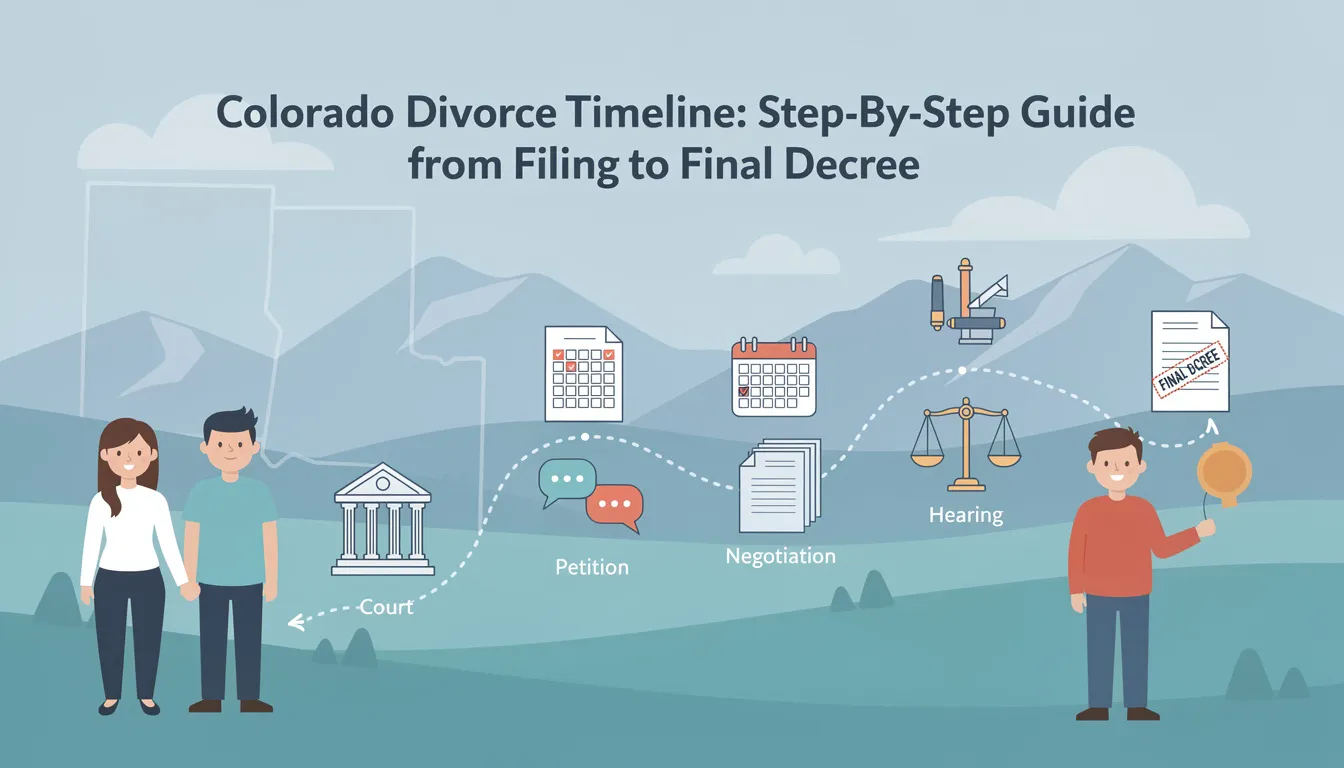
When you’re thinking about divorce, one of the first questions is simple:
“How long is this going to take?”
In Colorado, there is a clear legal framework – but the actual timeline depends on whether your case is uncontested or contested, whether you have children, how complex your finances are, and how cooperative everyone is.
Here’s the good news: once you understand the Colorado divorce timeline, you can make better decisions, avoid common delays, and use each stage to your advantage.
Colorado Divorce at a Glance
| Stage | What Happens | Typical Timing* |
|---|---|---|
| Eligibility check & planning | Residency, child’s residence, choosing divorce vs legal separation | 1–3 weeks |
| Filing & service | Petition filed, spouse served or waiver signed | Day 1–30 |
| 91‑day waiting period | Minimum time before a judge can finalize your divorce | Day 1–91+ |
| Initial Status Conference | First court conference to set deadlines | Within 42 days of filing |
| Financial disclosures | Sworn financial statement & mandatory documents exchanged | Within 42 days of filing or service |
| Mediation / negotiations | Settlement talks, parenting plans, property division | Months 2–5 (varies) |
| Temporary / permanent orders | Hearings if issues remain disputed | Months 3–9+ |
| Final decree | Judge signs decree of dissolution | No sooner than Day 91; often 3–6+ months |
*Timelines are typical ranges, not guarantees – complex or highly contested cases can take a year or more.
Throughout this guide, we’ll assume you’re filing in Colorado Springs / El Paso County or elsewhere in Colorado, and we’ll highlight where working with a seasoned Colorado Springs divorce attorney can speed things up or protect you from missteps.
Step 1: Make Sure You’re Eligible to File in Colorado
Before you look at calendars and court dates, confirm that Colorado is the right place to file.
1. Residency requirements
You can file for divorce (dissolution of marriage or civil union) in Colorado if:
- At least one spouse must have lived in Colorado for 91+ days immediately before filing.
- If you have minor children, they must have lived in Colorado for at least 182 days (six months) or, if they’re under six months old, since birth, for the court to enter parenting orders.
If you haven’t met these requirements yet, your timeline starts when you do.
2. Colorado is a pure “no‑fault” divorce state
Colorado doesn’t require you to prove adultery, cruelty, abandonment, or any other “fault.” The only legal ground is that the marriage is “irretrievably broken.”
This means your timeline is not affected by why the marriage is ending – but it can be affected by how much you disagree about:
- Parenting time and decision‑making
- Child support
- Division of property and debts
- Spousal maintenance (alimony)
3. Decision: divorce vs. legal separation
Colorado offers both divorce and legal separation. The procedures and timelines are almost identical; the key difference is that legal separation doesn’t end the marriage status.
If you later convert a legal separation to a divorce, there’s a separate (usually shorter) process.
Helpful resource: The Colorado Judicial Branch has a detailed Divorce & Legal Separation Self‑Help Center with forms and instructions. You can access it here.
Step 2: Prepare Strategically (1–3 Weeks)
You’ll move through the process much faster if you front‑load your preparation.
Documents to gather now
Start collecting:
- Recent pay stubs and W‑2s
- Last 3 years of tax returns
- Bank, retirement, and investment statements
- Mortgage, HELOC, vehicle loan, and credit card statements
- Deeds and titles for real estate and vehicles
- Health, life, and other insurance policies
- Any pre‑ or post‑nuptial agreements
- A rough list of household items and major personal property
If you have children, also start thinking about:
- School and activity schedules
- A realistic weekly parenting schedule
- Holidays and vacations
The more complete your picture, the easier it will be for your lawyer (or mediator) to help you design a workable settlement.
If you’re in the Pikes Peak region, consider scheduling a free consultation with the Colorado Springs divorce lawyers at Moran, Allen & Associates to map out your timeline before you file.
Step 3: File Your Case – Opening the Divorce (Day 1)
Your divorce “officially” starts when you file a Petition for Dissolution of Marriage or Legal Separation with the appropriate district court.
According to the Colorado Judicial Branch’s “How to File for Divorce or Legal Separation” instructions (Form JDF 1010), you will typically:
- Complete and file:
- Case Information Sheet (JDF 1000)
- Petition (JDF 1011) – with or without children
- Summons (JDF 1012) – not required if you both sign a joint petition
- File your forms:
- Either online e‑filing or in person with the court clerk
- Pay the filing fee or apply for a fee waiver (Forms JDF 205 & 206) if you qualify
- Receive:
- A case number
- A scheduled Initial Status Conference (ISC) date (usually within 42 days of filing)
Step 4: Serve Your Spouse – When the 91-Day Clock Really Starts
Colorado has a mandatory 91-day waiting period before a court can finalize your divorce – even if you agree on everything.
What matters is when that clock starts:
- Joint filing: If you both sign the petition, the 91 days start the day you file.
- Single filing: If only one of you files, the 91-day period starts when the other spouse is formally served with the summons and petition, or when they sign a Waiver and Acceptance of Service.
Service options
- Personal service by sheriff or private process server
- Waiver and Acceptance of Service if your spouse is cooperative
- Alternative service (such as publication) if your spouse cannot be located – this can add weeks or months to your timeline and absolutely warrants speaking with a lawyer.
Key takeaway: If you want the option of being divorced as close to Day 91 as possible, efficient and proper service is critical.
Step 5: Automatic Temporary Injunction – What You Can’t Do Now
The moment your petition is filed and served (or jointly filed), a powerful court order kicks in: the Automatic Temporary Injunction, required under C.R.S. § 14‑10‑107.
The injunction prohibits both spouses from, among other things:
- Transferring, hiding, or disposing of marital property outside the usual course of business or life necessities
- Harassing or disturbing the peace of the other spouse
- Removing children from Colorado without the other parent’s consent or a court order
- Canceling or changing insurance (health, auto, homeowner’s, renter’s, or life) without 14 days’ written notice and consent or a court order
Violating this injunction can lead to contempt of court and can badly hurt your credibility in front of the judge.
This is also when temporary issues – like who pays which bills or where the children will live while the case is pending – may be addressed through temporary orders. If spouses cannot agree on pressing issues, a Temporary Orders Hearing can be requested to address temporary arrangements during the divorce process. A skilled family law attorney in Colorado Springs can help you decide whether to request a temporary orders hearing or work toward a short‑term agreement.
Step 6: Initial Status Conference & Financial Disclosures (First 42 Days)
Initial Status Conference (ISC)
Colorado’s Rule 16.2 requires an Initial Status Conference within 42 days of filing. The Initial Status Conference in Colorado typically occurs within 42 days of filing the divorce petition.
At the ISC:
- You and your spouse (and lawyers, if you have them) meet with a judge or Family Court Facilitator (FCF).
- The court:
- Review fundamental issues (kids, property, support)
- Confirm deadlines for financial disclosures, mediation, and any evaluations
- May set future court dates (temporary orders, permanent orders, etc.)
The Initial Status Conference is typically held within 42 days of the petition being filed to set deadlines and discuss the case.
- You and your spouse (and lawyers, if you have them) meet with a judge or Family Court Facilitator (FCF).
- The court:
- Review fundamental issues (kids, property, support)
- Confirm deadlines for financial disclosures, mediation, and any evaluations.
- May set future court dates (temporary orders, permanent orders, etc.)
In truly uncontested cases with all paperwork completed, the court may waive the ISC – but most people will attend at least one.
Mandatory financial disclosures
Within 42 days after filing or receiving the petition, each spouse must file and exchange:
- Sworn Financial Statement (JDF 1111)
- Certificate of Compliance (JDF 1104) confirming you’ve provided:
- Tax returns
- Pay information
- Bank and retirement statements
- Debt statements
- Other required documents
Initial financial disclosures are mandatory in all divorce cases in Colorado, even if both spouses agree on the terms of the divorce.
The financial disclosures must include information about income, assets, debts, and monthly expenses.
Failing to complete these disclosures on time is one of the most common causes of delay in Colorado divorces – and one of the easiest problems to avoid if you start gathering documents in Step 2. The deadline to file financial disclosures is 42 days from the date the petition is served or filed.
Step 7: Negotiation, Parenting Plans & Mediation (Months 2–5)
Once the financial cards are on the table, you move into the heart of the Colorado divorce timeline: settlement discussions.
Separation Agreement & Parenting Plan
Most couples will either negotiate or mediate:
- Separation Agreement (JDF 1115) for property division and spousal maintenance
- Parenting Plan (JDF 1113) and Child Support Worksheet if there are children
This can be worked out:
- Directly between the spouses
- Through lawyers
- In mediation
Mediation: usually required before permanent orders
While Colorado doesn’t have a single statewide statute that says “every divorce must be mediated,” most courts require mediation before a permanent orders hearing, especially if any issues remain contested. In a contested divorce, the court may require mediation before proceeding to a final hearing to encourage the parties to reach an agreement.
The Colorado Judicial Branch’s Office of Dispute Resolution (ODR) offers court‑connected mediation at set rates, and many private mediators also handle family law cases.
During mediation:
- You and your spouse work with a neutral mediator
- Try to resolve as many issues as possible – ideally all of them
- If you settle, your agreement is written up and later submitted to the court for approval.
Tip: The 91‑day waiting period is an opportunity, not dead time. Couples who use these months to complete disclosures, mediation, and draft agreements are often ready to finalize as soon as the law allows.
If you have children, you may also need guidance on parental responsibilities and custody. The Colorado Springs child custody lawyers at Moran, Allen & Associates frequently help parents design parenting plans that judges are likely to approve.
Step 8: Temporary Orders, Discovery & Pre‑trial Prep (Months 3–9+)
If you’re not entirely settled, your case moves into deeper litigation.
Temporary orders (optional but standard)
Either spouse can request a Temporary Orders Hearing to get short‑term court orders on:
- Use of the family home
- Temporary child support or spousal maintenance
- Interim parenting time
- Payment of certain bills or debts
These orders stay in place until your permanent order (final ruling) or a later modification.
Discovery & experts
In more complex cases, your attorney may use discovery tools – interrogatories, document requests, depositions – and may recommend experts such as:
- Business valuators
- Real estate appraisers
- Child and Family Investigators (CFIs) or parental responsibility evaluators
- Vocational evaluators (for earning capacity disputes)
Formal information-gathering during the divorce process can include written questions, document requests, and depositions if the parties disagree.
- Business valuators
- Real estate appraisers
- Child and Family Investigators (CFIs) or parental responsibility evaluators
- Vocational evaluators (for earning capacity disputes)
All of this adds time – but can be essential to reaching a fair outcome in high‑conflict or high‑asset cases. Expert involvement, such as child and family investigators or parental responsibility evaluators, can significantly extend the duration of contested divorce cases.
Step 9: Permanent Orders Hearing or Affidavit‑Only Finalization
If you have a full agreement
If you completely agree on all issues and your paperwork is correct:
- You can often finalize shortly after the 91‑day waiting period, sometimes without appearing in court, using a Decree Without Appearance (JDF 1018) in cases without children. If both spouses agree on all terms in an uncontested divorce, they can finalize their divorce shortly after the 91-day waiting period. An uncontested divorce in Colorado is typically faster and simpler than a contested divorce because both parties agree on all major issues.
- Many courts still require a brief, uncontested hearing if there are children or if one spouse is unrepresented, to ensure the agreement is fair and in the children’s best interests.
If issues remain disputed
If you can’t reach a full agreement, your case will be set for a Permanent Orders Hearing (trial). A contested divorce in Colorado often involves multiple court appearances and can take significantly longer to resolve due to disagreements between the parties. Before the hearing, you’ll usually need to:
- Complete mediation and file a Certificate of Mediation
- File a Pretrial Statement (JDF 1129)
- File updated Sworn Financial Statements
- Exchange exhibits and identify witnesses
The Permanent Orders Hearing is the final step in the divorce process, during which the court resolves any unresolved issues.
- Complete mediation and file a Certificate of Mediation
- File a Pretrial Statement (JDF 1129)
- File updated Sworn Financial Statements
- Exchange exhibits and identify witnesses
At the hearing, the judge will decide:
- Property division and allocation of debts
- Parenting time and decision‑making
- Child support and spousal maintenance
- Any remaining contested issues
The judge then signs a Decree of Dissolution (JDF 1019), which legally ends the marriage.
How Long Does a Colorado Divorce Really Take?
Legally, the absolute minimum is 91 days, but that assumes:
- Prompt filing and service
- Complete disclosures
- Full agreement on everything
- No errors in your paperwork
In practice, recent Colorado guidance and law firm surveys show:
In practice, recent Colorado guidance and law firm surveys show:
- Uncontested divorces: Often 3–4 months from filing to decree, though the typical timeline for an uncontested divorce in Colorado ranges from 3-5 months.
- Typical contested divorces: Frequently 6–9 months
- High‑conflict / complex cases: 9–12+ months is not unusual
Most divorce cases in Colorado take six to nine months to finalize. However, Colorado divorce cases with contested issues can take 6-12 months or longer to resolve, depending on the complexity and the parties’ cooperation.
Working closely with an experienced Colorado Springs family law team that understands El Paso County’s specific procedures can help you keep your case moving and avoid self‑inflicted delays.
What Speeds Up (or Slows Down) a Colorado Divorce?
Things that speed your case up
- Filing a joint petition when appropriate
- Fast, clean service on the other spouse
- Completing disclosures early and accurately
- Being prepared and proactive for mediation
- Narrowing disputes to a small number of focused issues
- Hiring a lawyer who knows local court habits and expectations
Things that slow your case down
- Delayed or incomplete service
- Late or missing financial disclosures
- Disputes over parenting time or relocation
- Hidden assets, self‑employment, or complex business interests
- Domestic violence concerns or protection orders
- Repeated continuances or last‑minute changes of counsel
Helpful Colorado Authority & Directory Links
For additional reading and verification, you can visit:
- Colorado Judicial Branch – Divorce & Separation Self‑Help
Step‑by‑step information and official forms.
(Search “Divorce and Separation | Colorado Judicial Branch”) - How to File for Divorce or Legal Separation (JDF 1010)
Official two‑page checklist from the Colorado Judicial Branch. - Case Information Sheet (JDF 1000)
Required in all domestic relations cases. - Colorado Bar Association – Licensed Lawyer / Find‑a‑Lawyer Directory
Verified listings of Colorado attorneys by practice area and location. - Colorado Supreme Court – Attorney Search & Disciplinary History
Check an attorney’s license status and disciplinary history. - Office of Dispute Resolution (ODR)
Court‑affiliated mediation services and instructions on scheduling.
FAQs: Colorado Divorce Timeline
1. Can I really be divorced in 91 days in Colorado?
Legally, 91 days is the earliest a judge can enter a decree, starting from the date your spouse is served or you file jointly. In reality, only well‑prepared, uncontested cases with complete paperwork are likely to be finalized that quickly; most take longer.
2. How long do I have to live in Colorado before I can file?
At least 91 days of residency for one spouse before filing. If you have children, they must generally have lived in Colorado for 182 days (six months) before the court can issue custody and support orders.
3. Do we both have to go to court?
Not always. If you reach a full agreement, properly complete your Separation Agreement and (if applicable) Parenting Plan, and the judge finds them fair. In the child’s best interests, your divorce may be finalized on the papers or after a brief, uncontested hearing.
If you disagree on key issues, you should expect at least one court appearance – possibly more.
4. Is mediation required in Colorado divorces?
In most contested cases, yes. Colorado courts routinely order mediation before letting a case proceed to permanent orders. There can be exceptions (for example, in serious domestic violence situations), but it’s safest to assume you’ll be mediating at least once.
5. What if my spouse ignores the divorce papers?
Suppose your spouse is properly served and doesn’t respond within the time allowed. In that case, you may be able to request that the court enter default orders – but you must still prove that your requests are reasonable and provide complete financial and parenting information. The exact procedure is technical, so it’s wise to consult an experienced Colorado Springs divorce attorney.
6. Do I really need a lawyer if we agree on everything?
You’re not legally required to have an attorney, but Colorado’s own self‑help materials warn that self‑represented parties must follow the same rules and procedures as lawyers.
Even in an uncontested case, a brief consultation with a local family law attorney can:
- Catch missed assets or tax issues
- Make sure your parenting plan is detailed enough to avoid future conflict
- Help you draft an agreement that the judge is likely to approve the first time
Conclusion: Use the Colorado Divorce Timeline to Your Advantage
You can’t control everything about divorce. But you can control:
- How well you prepare
- How quickly you complete disclosures
- How realistic your settlement goals are
- Whether you have a knowledgeable advocate guiding you
If you’re in Colorado Springs or the greater El Paso County area, the team at Moran, Allen & Associates Family Law focuses exclusively on Colorado family law – from uncontested divorces to high‑conflict custody matters – and can help you build a clear, customized path from filing to final decree.
You don’t have to guess how long this will take or what comes next. With the right plan – and the proper support – the Colorado divorce timeline becomes a roadmap, not a mystery.
About the Author – Michael T. Allen
Michael Thomas Allen, Esq., is a Colorado Springs family law attorney and partner at Moran, Allen & Associates Family Law. He earned his B.A. from the University of Oregon and his Juris Doctor from the University of St. Thomas School of Law in Minneapolis.
Before entering private practice, Michael served the people of El Paso and Teller Counties as a prosecutor, gaining extensive courtroom experience in both misdemeanors and felonies. Today, his practice is devoted to divorce, child custody, protection orders, contempt proceedings, and related family law matters throughout Colorado’s Front Range.
Known for his preparation, professionalism, and steady courtroom presence, Michael helps clients navigate some of the most challenging moments in their lives with a focus on transparency, creativity, and loyal advocacy. When he’s not in court, he enjoys exploring Colorado’s mountain trails with his family.
This article is for informational purposes only and does not constitute legal advice. For advice about your specific situation, consult a licensed Colorado family law attorney.